
Google Business Profile 2026: what changed for EU local SEO
In Google Business Profile 2026, your Maps ranking now depends on your website, not just on the profile itself. Google changed how it reads structured data (LocalBusiness schema), rewards reviews and freshness more heavily, tightens photo verification and is rolling out AI — from review replies to calls placed on a customer's behalf. Each change shifts the weight of local SEO from the profile onto the content and data on your site. Below we break them down and show what to implement first.
Why your Maps ranking now depends on your website
Because Google treats the data on your site as the source of truth for the profile. Signals such as LocalBusiness schema, a consistent address (NAP) and FAQ content are read from the site and matched against your Maps profile. The more consistent your site and profile are, the higher and more often you appear in local results. A mismatch in hours, address or phone does the opposite — it lowers the algorithm's trust.
Why EU markets get these features later
Because most features launch first in English-speaking markets (US, UK, Ireland) and reach EU countries with a lag. Some, like AI calling, must also clear GDPR and Digital Markets Act scrutiny before going live. That delay is an advantage: the fundamentals below already work in every EU market today. Implement them now and you move ahead of competitors waiting for the official rollout.
Structured data that Google Business Profile reads
The cheapest lever in Google Business Profile 2026 is structured data on your site. Google reads hours, address, floor level and FAQ from it, then matches them with your Maps profile. Two markups make the biggest difference: LocalBusiness and FAQPage. We deploy both as the first technical step of our SEO & LLM retainer.
LocalBusiness — hours, address and floorLevel on site
Mark up your opening hours, address and floor level in LocalBusiness schema — Google treats it as the source of truth for the profile. Consistency between these fields and your Maps profile directly affects local visibility. For multi-country brands, template the block per location and per language. A complete minimum set looks like this:
- openingHours / openingHoursSpecification — opening hours, including the public-holiday exceptions that differ by EU country.
- address (PostalAddress) — full address matching your profile 1:1, in the local country format.
- floorLevel — the floor or level of your unit in multi-storey buildings.
- geo (latitude / longitude) — precise coordinates of the location.
- telephone — contact number in international format (+CC...).
FAQPage — how FAQ returns to Google Business Profile
FAQ counts toward the profile again, but only as FAQPage structured data embedded on your site — not typed manually into the profile. Google removed editable FAQs in early 2026 and restored their weight by reading questions and answers from schema-marked content. A well-built FAQ block gives a double win: a rich snippet in search and material that feeds the profile in each market. For EU brands serving several countries, localise it per language.
For every client on an SEO retainer we add a complete LocalBusiness structured-data block on the contact page and in the footer — with hours, address and phone consistent 1:1 with the profile. For multi-location EU brands we template it per location and per language. It is the cheapest, most durable lever in local SEO.
Local SEO is won not by whoever has the most listings, but by whoever's site and profile speak with one voice.
Reviews, freshness and photos in your profile
Three signals keep your Google Business Profile ranking high: reviews, regular updates and real photos. Profiles with no activity slide automatically, while Google rewards the ones that stay alive. This section breaks each signal into specifics. We start with reviews and update cadence.
Reviews and update cadence decide your ranking
The minimum standard is one update per month: a new post, fresh photos or replies to reviews. On top sits the growing weight of reviews — their number, recency and whether you respond. Profiles without this cadence lose position to more active competitors. The concrete minimum:
- Publish at least one post/update per month (offer, news, event).
- Add new photos regularly, not just once when you set up the profile.
- Reply to every review — positive and negative.
- Collect reviews continuously, not in quarterly bursts.
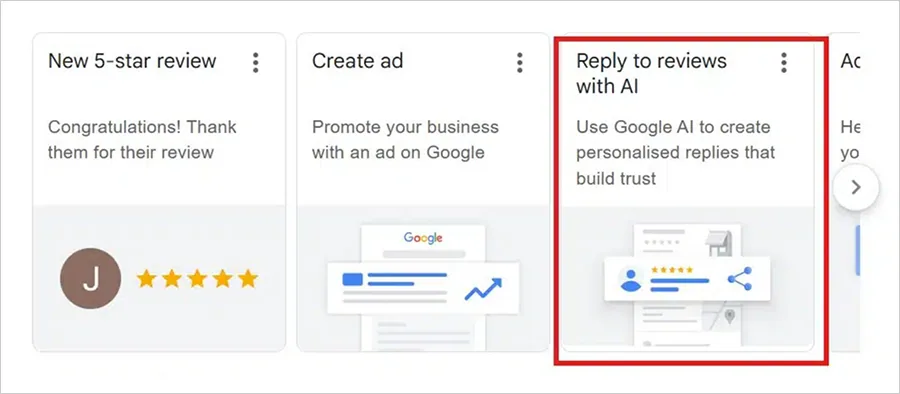
Replying to reviews with AI in your profile
The 'Reply to reviews with AI' button generates personalised responses — treat it as a draft to edit. A generic reply builds less trust than a specific one that references the review and the named service. Under GDPR, also note that the review text is processed by Google's AI when you use it.
Real, geotagged and described photos win
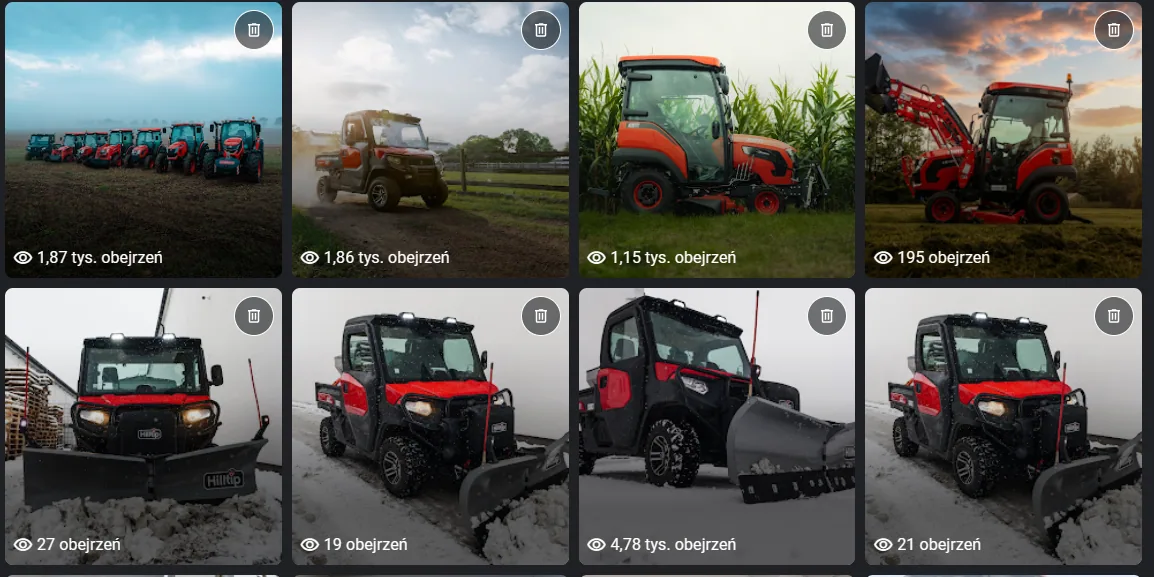
Add real photos with EXIF/GPS data and descriptive file names — Google demotes stock and AI imagery. The algorithm analyses metadata and the image itself, and the panel shows how many times each photo was viewed. Material from a production photo day works best — authentic and unique. The set we recommend:
- Real photos from your place of business, ideally with EXIF/GPS data intact.
- Descriptive file names instead of 'IMG_1234' — with brand, product and location.
- 360° interior views, so people can look around your premises.
- No stock graphics or AI images — they are caught and lose reach.
Described photo vs 'IMG_…': the view-count gap
The same machines with a descriptive title collect dozens of times more views than files named 'IMG_123'. Below is data from our client's profile in the agricultural-machinery sector — only the description and context differ, not the quality. The takeaway is simple: naming and description are a free visibility lever.
Google Business Profile photo views: descriptive title vs 'IMG_…' file name. Tractors in field (described): 1870; UTV in terrain (described): 1860; Tractor in maize (described): 1150; Machine 'IMG_…': 195; Plough 'IMG_…': 27; UTV 'IMG_…': 21.
Data from a client profile (agricultural machinery). Same machine types — only the photo description differs.
AI calling and the Google Business Profile checklist
The last change is AI calling businesses in Google Search, and the wrap-up is an implementation checklist. AI can call on a customer's behalf for prices, availability or hours — so your profile phone matters again. First we cover AI calling, then give a ready list of steps. Both are worth preparing before the feature reaches the EU.
AI calls local businesses in Google Search
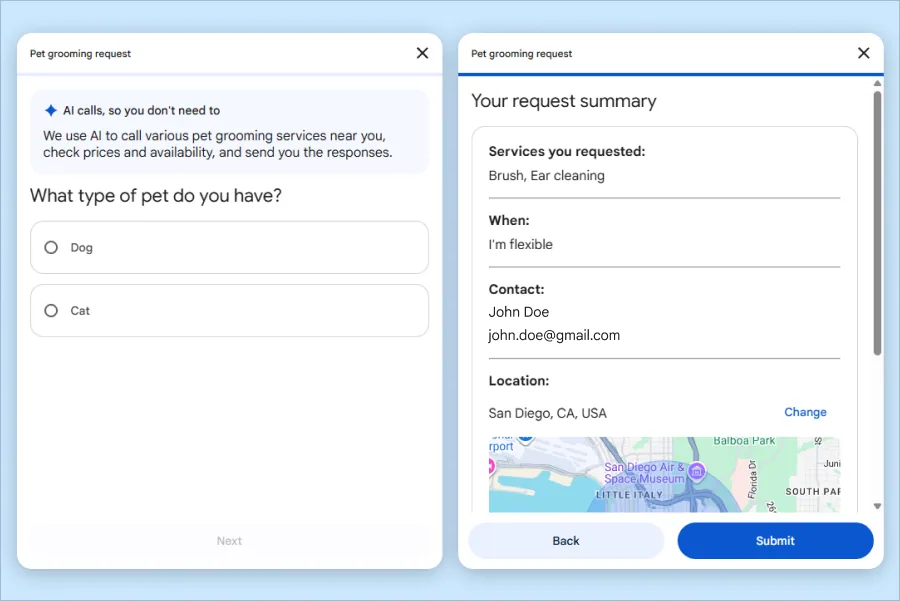
Google is testing a feature where AI calls local businesses on a customer's behalf — for prices, availability, wait times, bookings, hours or stock. It may also call to map your phone menu and keep the profile current. For businesses this means one thing: the phone number on your profile is a critical channel again, and whoever answers becomes part of the search experience. EU countries will see it later, so prepare consistent data and clear answers to common questions now.
Google Business Profile checklist for 2026
Get your Google Business Profile ready for 2026 by starting with structured data, then freshness, reviews and real photos. Below is the order we follow on local-SEO engagements, adapted for multi-country EU brands. Work through it top to bottom — each step works independently of any new feature launch.
- Implement LocalBusiness schema (hours, address, floorLevel, phone) consistent with the profile — per location.
- Add a FAQ section with FAQPage structured data, localised per language and market.
- Set a rhythm: at least one post and new photos per month.
- Reply to all reviews — AI can help, but edit the final wording by hand.
- Replace stock/AI photos with real, geotagged ones with descriptive names; add a 360° view.
- Make sure the profile phone is current and answered — ready for AI calling.
Local SEO and structured data are standard in every one of our SEO retainers — from LocalBusiness and FAQPage schema to a review and photo strategy, across single and multi-country EU setups. If you want your Google Business Profile to grow instead of slide, get in touch — we'll show a plan tailored to your sector.